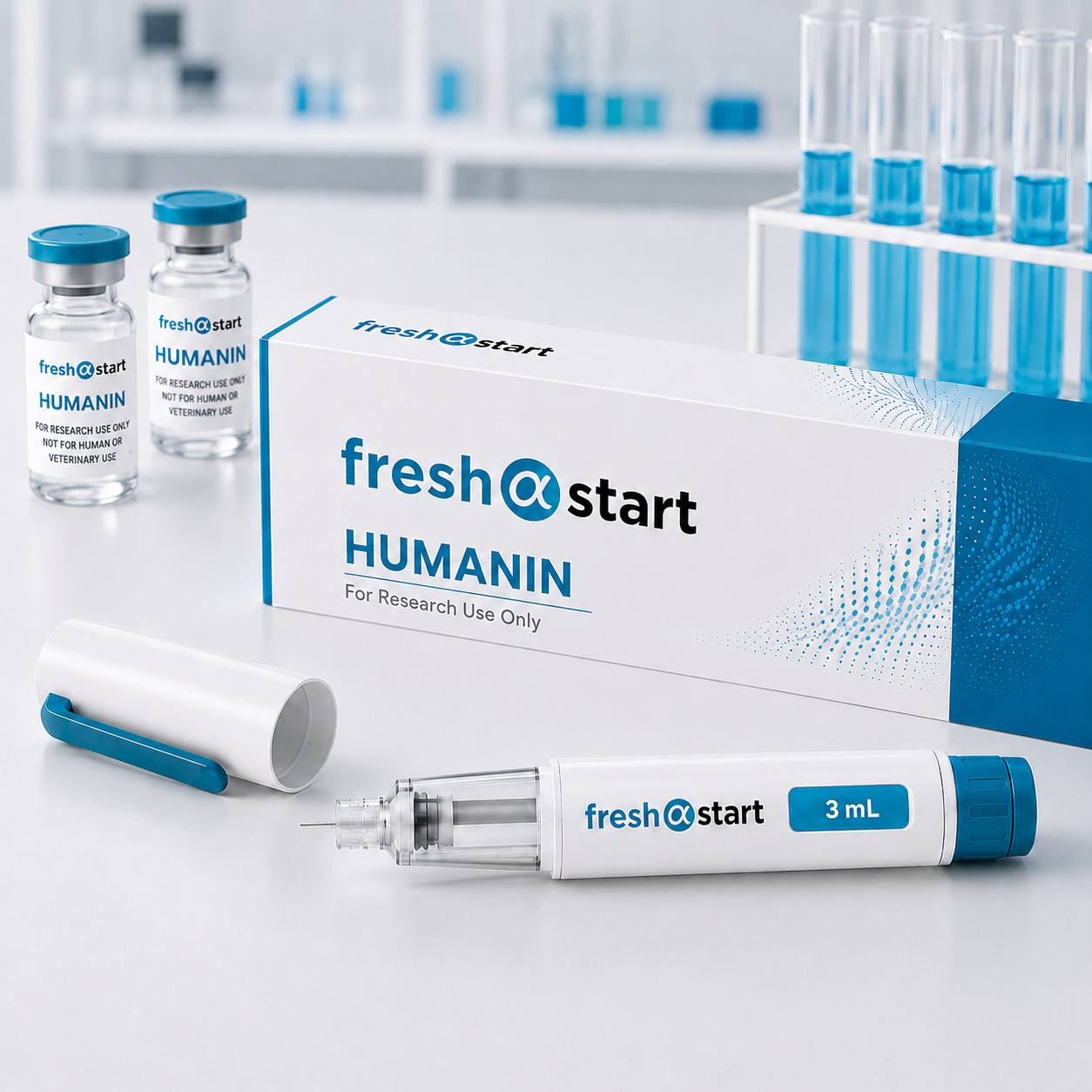
Humanin
Price range: £55.00 through £75.00
CAS No: On request
Strengths Available: 20mg
Format: Sealed containment / vial presentations available
Volume: 3mL
What This Product Is About
Humanin is a research-grade peptide studied in the context of growth hormone secretagogue and GH-axis signalling research. Investigators have explored how Humanin interacts with receptors and pathways involved in the regulation of growth hormone and downstream IGF activity.
Description
What is Humanin ?
Humanin is frequently referenced in research exploring growth hormone (GH) and insulin-like growth factor (IGF) signalling pathways. It has attracted scientific interest as a research tool for studying how the body’s GH-axis is regulated under controlled laboratory conditions.
Why Researchers Became Interested in Humanin
Researchers became interested in Humanin because of its relevance to GH-axis regulation and the broader study of metabolic and recovery pathways. It provides a defined research tool for examining growth-factor signalling in experimental models.
Key Research Focus Areas
- Growth hormone secretagogue signalling models
- GH / IGF-1 axis regulation studies
- Metabolic and body-composition research models
- Receptor-binding and pathway studies
- Recovery and tissue-maintenance research
- Endocrine signalling investigations
What the Research Has Shown
In preclinical research, Humanin has been studied for its influence on growth hormone signalling pathways and related downstream activity. Mechanistic studies have explored its interaction with receptors involved in the regulation of the GH-axis.
Scientific Background and Research Context
Humanin is an endogenous mitochondrial-derived peptide commonly described as a 24-amino-acid micropeptide encoded within the mitochondrial MT-RNR2 region. It was initially identified during research into neuronal survival and resistance to cellular damage associated with Alzheimer’s disease. Since its discovery, Humanin has become an important research subject in mitochondrial biology, ageing science and cellular stress-response studies.
Unlike conventional signalling molecules encoded by nuclear DNA, Humanin belongs to a developing group of biologically active molecules produced from small open reading frames within mitochondrial DNA. These peptides are being investigated as communication signals that allow mitochondria to influence cellular metabolism, inflammation, stress resistance and survival pathways.
Exploring the Science Behind
Humanin has primarily been studied for its potential cytoprotective and neuroprotective properties. Laboratory experiments suggest that it may help cells respond to oxidative stress, oxygen deprivation, nutrient restriction and other conditions capable of disrupting normal mitochondrial function. These observations have mainly been reported in cellular and animal research models and should not be interpreted as evidence of established clinical effectiveness.
Research indicates that Humanin may operate through both intracellular and extracellular mechanisms. Extracellular Humanin has been shown to interact with receptor systems containing GP130, activating signalling pathways such as STAT3, AKT and ERK1/2. These pathways are associated with cellular survival, stress adaptation and metabolic regulation. Intracellularly, Humanin has also been investigated for its interactions with proteins involved in apoptosis and mitochondrial membrane stability.
Humanin and laboratory-developed analogues have also been examined in models involving amyloid-beta toxicity, cerebral ischaemia, mitochondrial dysfunction and age-related cellular damage. However, the precise biological mechanisms, receptor interactions and tissue-specific effects remain active areas of investigation.
Research Context in Endocrine and Metabolic Science
Humanin has attracted interest in endocrine and metabolic research because of its proposed relationship with insulin signalling, glucose regulation and the growth hormone–IGF-I system. Experimental studies suggest that Humanin may interact with insulin-like growth factor-binding protein 3, commonly known as IGFBP-3, and may participate in the wider regulation of IGF-I activity.
Animal and cellular studies have explored whether Humanin may influence insulin sensitivity, pancreatic beta-cell survival, inflammatory signalling and metabolic responses to ageing. Researchers are also investigating whether changes in circulating Humanin concentrations could provide information about mitochondrial function, metabolic stress or age-related physiological changes.
These findings remain preliminary. Humanin has not been established as a treatment for diabetes, metabolic disorders, hormonal imbalance or age-related disease. Further controlled research is required to determine its pharmacology, biological relevance, safety profile and possible clinical applications.
Ongoing Scientific Interest
Humanin remains scientifically significant because it connects several major research areas, including mitochondrial communication, cellular ageing, neurobiology, cardiovascular science and metabolic regulation. Studies involving experimental organisms have reported associations between Humanin signalling, stress resistance and metabolic healthspan. Humanin concentrations have also been observed to change with age in certain research populations and animal models, although the biological meaning of these findings is not yet fully understood.
Current investigations continue to examine Humanin and its analogues in models of neurodegeneration, cardiovascular stress, retinal damage, inflammation and mitochondrial dysfunction. Researchers are also evaluating possible context-dependent risks because increasing cellular survival may not be beneficial in every biological environment, particularly where abnormal or malignant cells are present.
Humanin should therefore be regarded as an experimental research peptide rather than an approved medicine or proven longevity intervention. Its emerging role in mitochondrial signalling continues to make it a valuable subject for controlled laboratory investigation.
For research and laboratory use only. Not intended for human consumption, medical treatment or diagnostic use.
Ingredient Profile
Single research compound: Humanin
CAS: On request
Supplied as lyophilised powder (no excipients, fillers or additives).
Active Ingredients
Humanin — 10mg
Ingredient Breakdown
Humanin: 10mg of active peptide per vial (lyophilised).
Why is Humanin studied in growth-hormone research?
Because studies have explored its relevance to growth hormone and IGF-axis signalling pathways.
Is Humanin approved for medical use?
No. It is supplied strictly for research and laboratory use only, and is not intended for human or veterinary use.
Why does purity matter so much for this product?
High purity helps ensure that observed research effects are due to the material itself rather than impurities.
What does ‘research grade’ mean?
It means the product is supplied with documentation and traceability for laboratory investigation.
Is international supply available?
Yes. International fulfilment and temperature-controlled shipping can be supported where appropriate.
Research & laboratory use only. Not for human or veterinary use. Not a medicinal product, supplement, food or medical device. No therapeutic, diagnostic, cosmetic, wellness or lifestyle claims are made or implied. Analytical reference/click information is a laboratory measurement aid only and must not be applied to living systems.
Typically supplied at >99% purity, supported by batch-specific analytical data. UK-based preparation, analysis and release under scientist-led, GMP-aligned processes with full batch-level traceability. Certificate of Analysis (CoA) available on request; independent analytical verification where appropriate.
Store the lyophilised powder refrigerated at 2–8°C, protected from light and moisture; suitable for longer-term storage frozen at -20°C. Handle under appropriate laboratory conditions. For in vitro research use only.
For in vitro laboratory research only. Reconstitution, handling and experimental design at the discretion of the qualified researcher. The 300-click sealed-containment system is an analytical measurement reference only and does not represent dosing or administration guidance. Not for use in living systems.
Partner with FreshstartPharma– Where Accuracy Meets Innovation
Freshstartpharma is committed to delivering high-quality research-grade products designed for advanced scientific applications. We offer wholesale partnerships to selected businesses that share our values of integrity, quality, and innovation. Whether you’re an established distributor or an emerging research supply company, we invite you to join our network and benefit from exclusive access to our state-of-the-art product range.
Related Products
5-Amino-1MQ
AOD-9604
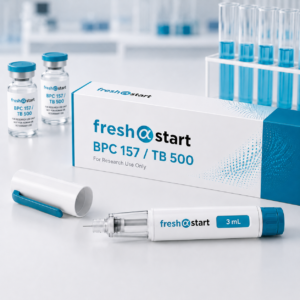
BPC 157/TB 500