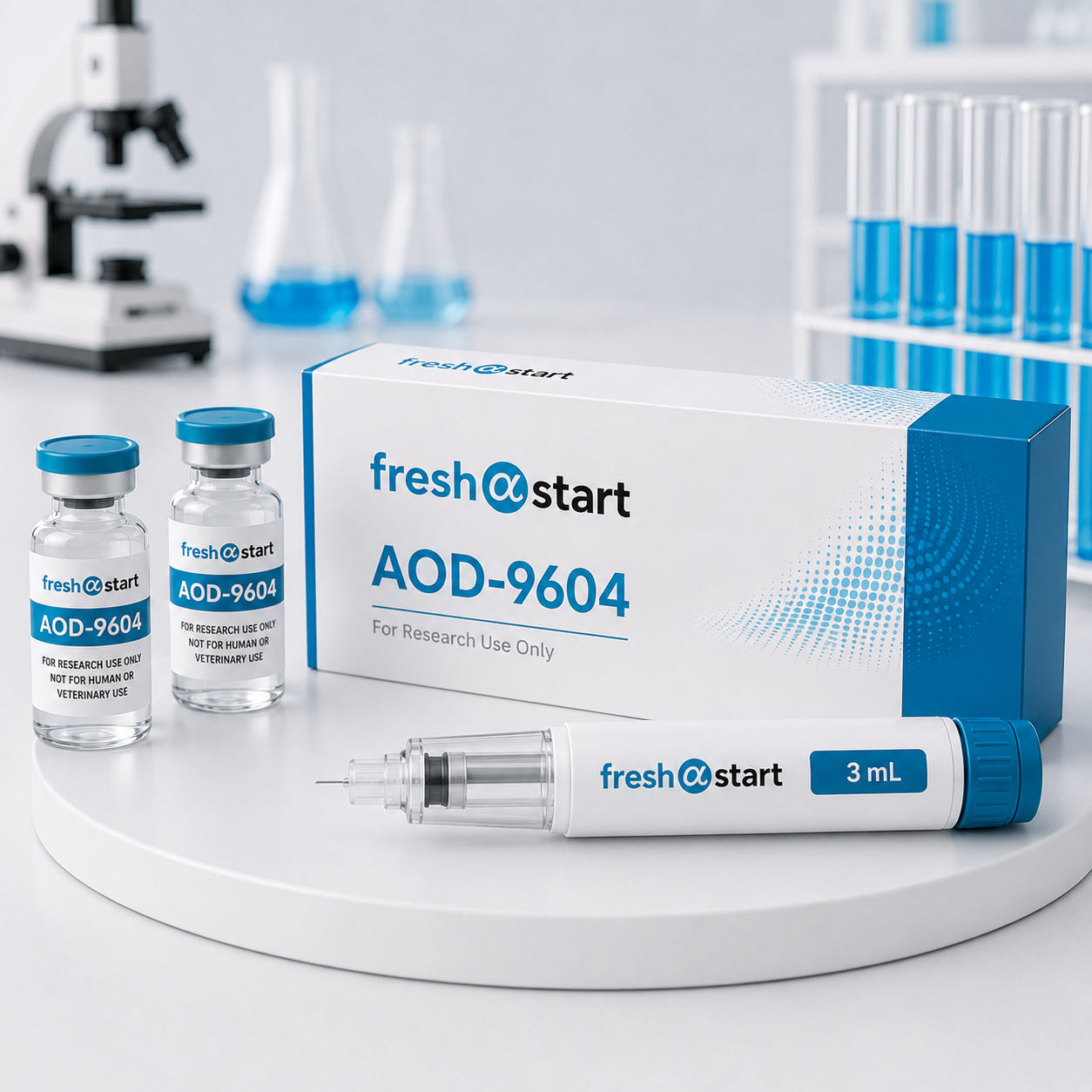
AOD-9604
CAS: 221231-10-3
What is AOD-9604 about?
Strengths Available: 2gm /5mg / 10mg
Format: Sealed containment / vial presentations available
Volume: 3mL
AOD 9604 is a research-grade peptide studied in the context of metabolic signalling, energy balance, and related receptor pathways. Investigators have explored how AOD 9604 interacts with pathways relevant to glucose handling, appetite regulation, or lipid metabolism in laboratory models.
Description
What is AOD-9604?
AOD-9604 is a compound that has generated sustained interest in research communities because of how it helps scientists explore one very specific question: how fat tissue behaves at a biological level. Although it is often mentioned in conversations about fat loss, its real value lies in what it allows researchers to observe and measure under controlled laboratory conditions.
This page explains AOD-9604 in straightforward terms, outlining why it was developed, what the research has explored, and why it remains relevant today as a research material.
- It separates fat biology research from growth hormone
effects - It has been explored across laboratory, animal, and historical
clinical-stage studies - It provides a controlled way to study lipid metabolism and
adipose tissue behaviour
Key Research Focus Areas
- Adipose tissue biology and fat cell signalling
- Lipolysis and fat mobilisation pathways
- Metabolic signalling related to fat storage and energy use
- Comparisons between selective peptide signalling and full
growth hormone activity
What the Research Has Shown
In preclinical research, particularly animal models, AOD-9604 has been associated with changes in fat mass and lipid metabolism markers. These findings helped establish its reputation as a compound of interest in fat biology research.
The compound was later investigated in clinical-stage studies related to obesity. While early trials suggested modest effects, later studies did not consistently confirm strong clinical outcomes.
As a result, development was discontinued and the compound remained within the research domain.
This history is important because it frames AOD-9604 accurately: it is best understood as a research tool with a meaningful scientific backstory, rather than a proven medical treatment.
Scientific Background and Research Context
AOD-9604 is a synthetic peptide fragment derived from the C-terminal region of human growth hormone, commonly described as a modified analogue of hGH fragment 176–191 / 177–191. Unlike full-length growth hormone, AOD-9604 was designed to focus on the fat-metabolism-related region of the molecule while avoiding broader growth hormone activity, such as effects on growth promotion or glucose regulation.
AOD-9604 attracted scientific interest because human growth hormone has long been associated with lipolytic and anti-lipogenic activity, meaning it may influence the breakdown and storage of fat. Researchers investigated whether a smaller peptide fragment could reproduce some of these metabolic effects without the wider systemic actions of full growth hormone.
Early preclinical studies reported that AOD-9604 reduced weight gain and increased lipolytic activity in obese animal models, particularly in studies using obese Zucker rats and mice. These findings positioned AOD-9604 as a research compound of interest in fat-metabolism and body-composition science.
Exploring the Science Behind GLP-1
The scientific basis for AOD-9604 comes from research into the lipolytic domain of human growth hormone. This region has been studied for its potential role in adipose-tissue metabolism, especially the regulation of fat breakdown and fat formation.
In preclinical research, AOD-9604 and related hGH fragments have been associated with increased fat oxidation, reduced fat accumulation, and altered lipid metabolism in adipose tissue. Some mechanistic work suggests involvement of the beta-adrenergic pathway, particularly beta-3 adrenergic receptor signalling, which is relevant to fat-cell metabolism and thermogenic activity.
Research Context in Metabolic and Body-Composition Science
AOD-9604 has mainly been investigated in the context of obesity research, adipose-tissue biology, and metabolic regulation. Its relevance comes from the idea that a small peptide fragment may selectively influence lipid metabolism without acting like full human growth hormone.
However, the research picture is mixed. Animal and ex vivo adipose-tissue studies showed promising effects on lipolysis and fat metabolism, but human research has been more limited and has not established AOD-9604 as a proven weight-loss therapy. Reviews of obesity pharmacotherapy have described AOD-9604 as an orally active analogue of the hGH 177–191 fragment that selectively activates lipolysis in adipose tissue, while also noting that development of obesity treatments in this area remained investigational.
Ongoing Scientific Interest
AOD-9604 remains relevant in research because it represents an attempt to separate the metabolic actions of human growth hormone from its broader endocrine effects. It is commonly discussed in studies relating to:
- Adipose-tissue metabolism
- Lipolysis and fat oxidation
- Anti-lipogenic signalling
- Beta-adrenergic pathway interaction
- Body-composition research
- Growth hormone fragment biology
Overall, AOD-9604 is best understood as a research peptide connected to the study of fat metabolism and hGH-derived peptide signalling, rather than as a clinically established obesity treatment.
For research and laboratory use only. Not for human or veterinary use.
Ingredient Profile
Single research compound: AOD-9604. CAS: 221231-10-3. Purity >99%. Supplied as lyophilised powder (no excipients, fillers or additives).
Active Ingredients
AOD-9604 — 2 / 5 / 10mg
Ingredient Breakdown
AOD-9604: 2 / 5 / 10mg of active peptide per vial (lyophilised).
Why is AOD 9604 studied in metabolic research ?
AOD-9604 is studied because it is a synthetic fragment of human growth hormone linked to the lipolytic domain of hGH. Researchers became interested in it because early animal studies suggested it may influence fat metabolism, including lipolysis, fat oxidation, and reduced fat accumulation, without producing the broader growth-promoting effects associated with full-length growth hormone.
Is AOD 9604 approved for medical use?
No. AOD-9604 is not approved as a medical treatment by major drug regulators such as the FDA, EMA, or TGA. It has been studied experimentally, but it has not been established as an approved medicine for obesity, weight loss, or metabolic treatment. Some sources note a GRAS-related food/nutraceutical safety status in limited contexts, but that is not the same as approval as a therapeutic medicine.
Why does purity matter so much for this product?
High purity helps ensure that experimental results reflect the compound itself rather than impurities.
What does ‘research grade’ mean?
It means the product is supplied with documentation and traceability for laboratory investigation.
Is international supply available?
Yes. International fulfilment and temperature-controlled shipping can be supported where appropriate.
Research & laboratory use only. Not for human or veterinary use. Not a medicinal product, supplement, food or medical device. No therapeutic, diagnostic, cosmetic, wellness or lifestyle claims are made or implied. Analytical reference/click information is a laboratory measurement aid only and must not be applied to living systems.
Typically supplied at >99% purity, supported by batch-specific analytical data. UK-based preparation, analysis and release under scientist-led, GMP-aligned processes with full batch-level traceability. Certificate of Analysis (CoA) available on request; independent analytical verification where appropriate.
Store the lyophilised powder refrigerated at 2–8°C, protected from light and moisture; suitable for longer-term storage frozen at -20°C. Handle under appropriate laboratory conditions. For in vitro research use only.
For in vitro laboratory research only. Reconstitution, handling and experimental design at the discretion of the qualified researcher. The 300-click sealed-containment system is an analytical measurement reference only and does not represent dosing or administration guidance. Not for use in living systems.
Partner with FreshstartPharma– Where Accuracy Meets Innovation
Freshstartpharma is committed to delivering high-quality research-grade products designed for advanced scientific applications. We offer wholesale partnerships to selected businesses that share our values of integrity, quality, and innovation. Whether you’re an established distributor or an emerging research supply company, we invite you to join our network and benefit from exclusive access to our state-of-the-art product range.