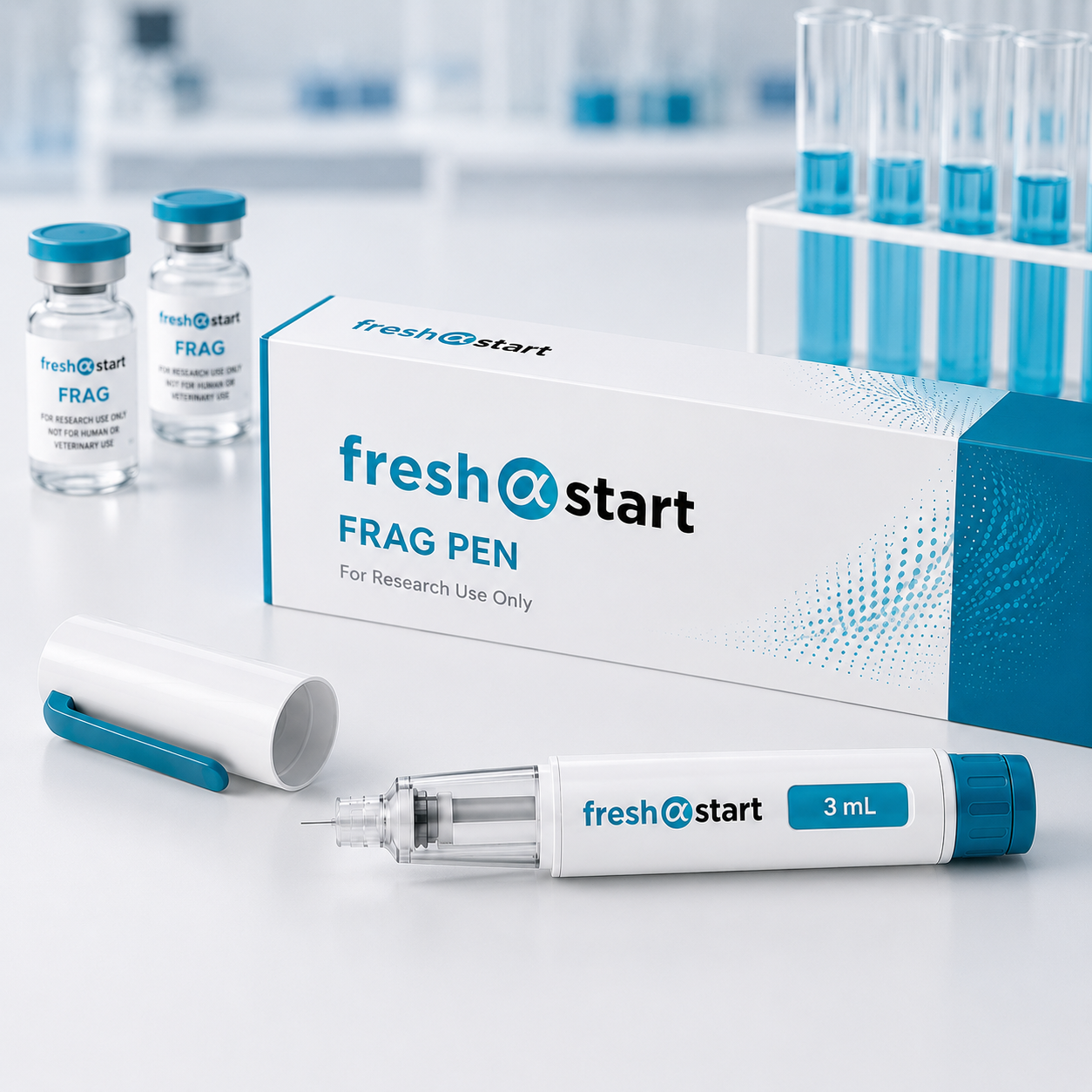

FRAG
CAS Number: 66004-57-7
Strengths Available: 2mg / 5mg
Format: Sealed containment / vial presentations available
Volume: 3mL
What FRAG is about?
FRAG 176-191 is a synthetic peptide corresponding to a fragment of the human growth hormone molecule. It is a specific peptide fragment derived from the C-terminal region of human growth hormone.
Description
Scientific Background and Research Context
FRAG 176-191 is a synthetic peptide fragment derived from the C-terminal region of human growth hormone (hGH). It has attracted scientific interest in metabolic and adipose tissue research due to its role in studies investigating lipid metabolism and energy regulation.
Researchers use FRAG 176-191 to explore specific biological pathways associated with fat metabolism and peptide signalling under controlled laboratory conditions.
This product is supplied exclusively for research and laboratory investigation. It is not intended for human or veterinary use, and no therapeutic or medical claims are made or implied.
What the Research Has Shown
Why Researchers Are Paying Attention to FRAG
Few metabolic research peptides have attracted as much scientific interest in recent years as Fragment 176-191 (FRAG).
As researchers continue to investigate metabolism, energy utilisation, adipose tissue biology, and body composition, FRAG has emerged as a significant area of laboratory investigation. Scientific interest has largely centred on its relationship to pathways involved in lipid metabolism and energy regulation, making it an increasingly studied compound within metabolic research.
The growing attention surrounding FRAG reflects not only current scientific understanding but also the ongoing effort to better understand the complex biological processes involved in energy balance, metabolic signalling, and cellular function.
Exploring the Science Behind Fragment 176-191
Modern metabolic research continues to explore the biological pathways associated with body composition and energy metabolism.
Fragment 176-191 is a peptide derived from a specific region of the growth hormone molecule and has been widely investigated for its interaction with metabolic pathways involved in lipid utilisation and cellular energy processes. Researchers continue to examine how this peptide behaves within controlled laboratory models to better understand the mechanisms that regulate metabolic activity.
As scientific knowledge of metabolic biology expands, FRAG remains an important research compound for studying the complex relationship between energy regulation, adipose tissue biology, and cellular metabolism.
Cellular Energy: Understanding Metabolic Activity
Every cell depends upon efficient energy production to support normal biological processes.
For this reason, researchers have investigated FRAG in studies exploring cellular energy balance, metabolic efficiency, and the biological pathways involved in nutrient utilisation. Scientific investigations continue to examine how metabolic signalling contributes to maintaining energy homeostasis and overall cellular function.
By studying these mechanisms, researchers aim to improve understanding of how cells regulate energy availability under a variety of experimental conditions.
This area continues to represent one of the fastest-growing disciplines within metabolic and cellular research.
Research into Body Composition and Metabolic Function
One of the primary areas of FRAG research focuses on adipose tissue biology and metabolic regulation.
Adipose tissue is recognised as a highly active metabolic organ that plays an important role in energy storage, hormone signalling, and cellular communication. Laboratory studies have explored how metabolic pathways associated with lipid metabolism may influence adipocyte activity, nutrient utilisation, and overall energy balance.
These investigations form part of broader scientific efforts to better understand the biological mechanisms that contribute to body composition and metabolic regulation.
As interest in metabolic science continues to expand, FRAG remains an established compound within ongoing laboratory research programmes.
Metabolic Science and Healthy Ageing Research
Another reason for the continued interest in FRAG is its relevance to metabolic health and healthy ageing research.
Scientists continue to investigate the biological processes associated with long-term cellular function, metabolic flexibility, tissue maintenance, and energy regulation throughout the ageing process. Research into metabolic pathways may provide valuable insights into how cells adapt to changing energy demands and maintain biological efficiency over time.
These investigations contribute to a broader scientific objective of understanding the mechanisms that support cellular resilience and metabolic function throughout life.
As longevity science continues to develop, metabolic research peptides remain an important focus across academic, biotechnology, and pharmaceutical research.
Why Interest Continues to Grow
The fields of metabolism, body composition, cellular energy, and longevity remain among the most active areas of modern bioscience.
Within these disciplines, FRAG has become a widely recognised research peptide due to its relevance to metabolic signalling and lipid metabolism research. Scientists continue to investigate its role in expanding understanding of complex biological pathways associated with energy utilisation and cellular function.
Researchers continue to explore its potential role in advancing scientific understanding of:
- Metabolic regulation
- Lipid metabolism
- Cellular energy production
- Adipose tissue biology
- Body composition science
- Healthy ageing research
- Energy utilisation pathways
- Metabolic signalling mechanisms
As new research continues to emerge, scientific interest in FRAG remains strong across multiple areas of metabolic and cellular investigation.
Research Use Only
Within the our portfolio, Fragment 176-191 (FRAG) is supplied strictly for laboratory, analytical, and scientific research purposes. It is intended to support experimental workflows, compound evaluation, pathway investigation, and controlled laboratory studies only.
Important Notice: Fragment 176-191 (FRAG) is not approved for human consumption, medical use, diagnosis, treatment, cure, or prevention of any disease. All references on this page relate exclusively to scientific and laboratory research. No therapeutic, medical, or health claims are made or implied.
Ingredient Profile
Single research compound: HGH Fragment 176-191 (FRAG). CAS: 66004-57-7. Purity >99%. Supplied as lyophilised powder (no excipients, fillers or additives).
Active Ingredients
HGH Fragment 176-191 (FRAG) — 5mg / 10mg
Ingredient Breakdown
HGH Fragment 176-191 (FRAG): 5mg / 10mg of active peptide per vial (lyophilised).
What is FRAG 176-191?
FRAG 176-191 is a synthetic peptide corresponding to a fragment of the human growth hormone molecule.
Is FRAG 176-191 growth hormone?
No. FRAG 176-191 is not growth hormone. It is a specific peptide fragment derived from the C-terminal region of human growth hormone.
Why is FRAG 176-191 studied?
Researchers study it to investigate metabolic signalling, adipose tissue biology, and peptide-mediated cellular pathways.
Is FRAG 176-191 the same as HGH?
No. HGH is the complete growth hormone molecule, whereas FRAG 176-191 is only a small fragment of that molecule.
Why is FRAG 176-191 commonly researched alongside growth hormone?
Because it originates from the growth hormone sequence and may provide insight into the biological activity of specific hormone-derived peptide fragments.
Is FRAG 176-191 approved for medical use?
No. This product is supplied strictly for research and
laboratory investigation only.
Why does purity matter for FRAG 176-191 research?
High purity helps ensure that observed experimental results are attributable to the peptide itself.
What does “research grade” mean?
It indicates documentation, analytical verification, and traceability suitable for laboratory investigation.
What is the sealed containment device used for?
It provides a consistent analytical measurement reference for laboratory workflows.
Does the click system represent dosing?
No. It is an analytical reference only and does not constitute administration guidance.
Can FRAG 176-191 be supplied internationally?
Yes. International fulfilment and temperature-controlled shipping can be supported where required.
Research & laboratory use only. Not for human or veterinary use. Not a medicinal product, supplement, food or medical device. No therapeutic, diagnostic, cosmetic, wellness or lifestyle claims are made or implied. Analytical reference/click information is a laboratory measurement aid only and must not be applied to living systems.
Typically supplied at >99% purity, supported by batch-specific analytical data. UK-based preparation, analysis and release under scientist-led, GMP-aligned processes with full batch-level traceability. Certificate of Analysis (CoA) available on request; independent analytical verification where appropriate.
Store the lyophilised powder refrigerated at 2–8°C, protected from light and moisture; suitable for longer-term storage frozen at -20°C. Handle under appropriate laboratory conditions. For in vitro research use only.
For in vitro laboratory research only. Reconstitution, handling and experimental design at the discretion of the qualified researcher. The 300-click sealed-containment system is an analytical measurement reference only and does not represent dosing or administration guidance. Not for use in living systems.
Partner with FreshstartPharma– Where Accuracy Meets Innovation
Freshstartpharma is committed to delivering high-quality research-grade products designed for advanced scientific applications. We offer wholesale partnerships to selected businesses that share our values of integrity, quality, and innovation. Whether you’re an established distributor or an emerging research supply company, we invite you to join our network and benefit from exclusive access to our state-of-the-art product range.