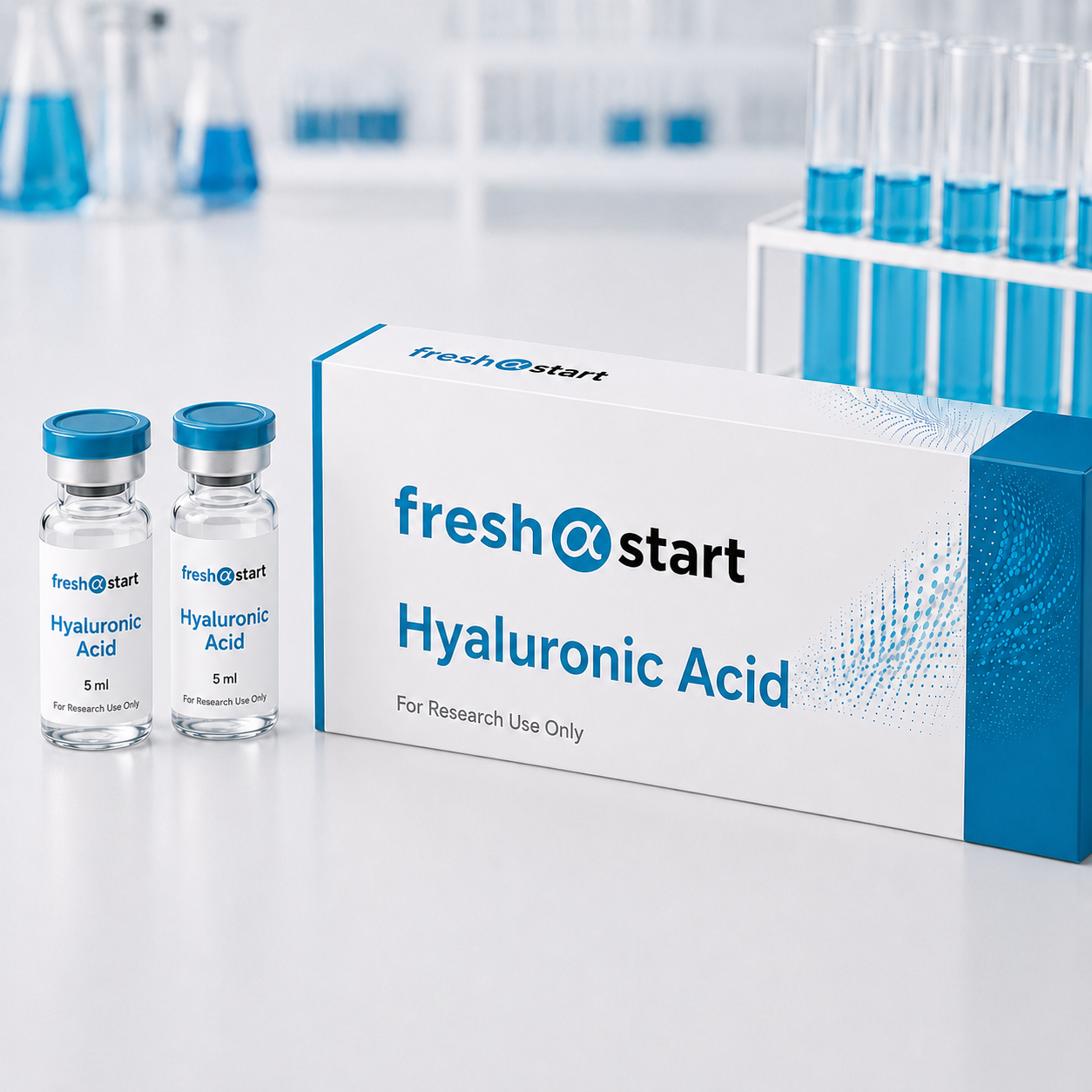
Hyaluronic Acid
CAS No: 9004-61-9
Strengths Available: 5mg/10mg
Format: Sealed containment / vial presentations available
Volume: 3mL
What This Product Is About
Hyaluronic acid is a naturally occurring glycosaminoglycan found throughout connective tissues, skin, joints and the eyes. It is widely studied for its ability to retain water and support tissue structure.
Description
What is Hyaluronic Acid?
Hyaluronic acid is a naturally occurring polysaccharide that binds water and contributes to hydration, lubrication and extracellular-matrix structure.
Why Researchers Became Interested in Hyaluronic Acid
Researchers became interested in hyaluronic acid because of its important role in skin hydration, joint lubrication, wound repair and tissue regeneration.
Key Research Focus Areas
- Skin hydration
- Extracellular matrix
- Joint and cartilage research
- Wound healing
- Tissue regeneration
- Dermal fillers
- Ophthalmology
- Drug-delivery systems
What the Research Has Shown
Research has established that hyaluronic acid can retain large amounts of water and influence tissue hydration, lubrication and cellular signalling. Its properties vary considerably depending on molecular weight, formulation and method of administration.
Hyaluronic acid—commonly called hyaluronan in scientific literature—is a naturally occurring, non-sulphated glycosaminoglycan. It consists of repeating units of glucuronic acid and N-acetylglucosamine and is synthesised directly at the cell membrane before being released into the extracellular space.
It is widely distributed throughout connective tissues, skin, cartilage, synovial fluid, the vitreous humour of the eye and the extracellular matrix. Because hyaluronic acid attracts and retains water, it contributes to tissue hydration, lubrication, volume and resistance to compression. In cartilage, it also provides a structural backbone for large proteoglycan aggregates that help joints tolerate mechanical loading. NCBI Bookshelf
Exploring the Science Behind
Hyaluronic acid is no longer considered simply a passive moisturising or structural molecule. Research indicates that it can interact with cell-surface receptors—including CD44 and RHAMM—and participate in signalling pathways associated with cell adhesion, migration, proliferation, immune-cell recruitment and extracellular-matrix organisation.
Its biological activity depends partly on molecular size. High-molecular-weight hyaluronan is generally associated with tissue structure, hydration and homeostasis, while smaller fragments generated during injury or inflammation may act as signalling molecules. These fragments can influence inflammatory pathways and help coordinate the transition between tissue damage, repair and remodelling. The effects remain highly dependent on polymer size, concentration, tissue location and receptor environment. PubMed, PubMed
Research Context in Endocrine and Metabolic Science
Hyaluronic acid is not a hormone, but it is relevant to endocrine and metabolic research because extracellular-matrix turnover affects how cells respond to biochemical and mechanical signals.
Research areas include:
Regulation of hyaluronic-acid synthesis by the HAS1, HAS2 and HAS3 enzymes.
Enzymatic degradation and clearance during normal tissue turnover.
Extracellular-matrix changes associated with metabolic inflammation.
Cartilage metabolism and the response of chondrocytes to mechanical stress.
Fibroblast activity, collagen organisation and connective-tissue remodelling.
Interactions between hyaluronan, immune cells and inflammatory mediators.
Changes in skin hydration, elasticity and matrix organisation during ageing.
Its involvement in cell migration and angiogenesis during wound healing.
Researchers are particularly interested in how hyaluronan turnover changes during injury, chronic inflammation, fibrosis and degenerative joint conditions. Different molecular-weight forms may produce different—and sometimes opposing—cellular responses. NCBI Bookshelf, PubMed
Ongoing Scientific Interest
Scientific interest continues around the use of hyaluronic acid as both a biological signalling molecule and a biomaterial. Its water-binding capacity, biocompatibility and ability to be chemically modified make it useful in research involving hydrogels, wound dressings, tissue scaffolds, injectable materials and controlled drug-delivery systems.
Ingredient Profile
Single research compound: Hyaluronic acid
CAS: 9004-61-9
Supplied as lyophilised powder (no excipients, fillers or additives).
Active Ingredients
Hyaluronic acid — 5 mg / 10 mg
Ingredient Breakdown
Hyaluronic acid : 5 mg / 10 mg of active peptide per vial (lyophilised).
Why is Hyaluronic Acid studied in metabolic research?
Hyaluronic acid is more commonly studied in tissue biology, dermatology, regenerative medicine and extracellular-matrix research than general metabolic research.
Is Hyaluronic Acid approved for medical use?
Yes, in specific formulations and applications. Hyaluronic-acid-based products are used in approved medical products such as certain dermal fillers, ophthalmic preparations and joint injections. Regulatory status varies by formulation and country.
Why does purity matter so much for this product?
Purity is important because contaminants, residual proteins, endotoxins or variations in molecular weight can influence biological behaviour and research results.
What does “research grade” mean?
Research grade means the material is intended for laboratory or analytical research and does not automatically mean it is sterile, injectable or approved for human use.
Is international supply available?
International availability depends on the product format, supplier, destination country and applicable regulations for cosmetic, medical or research materials.
Research & laboratory use only. Not for human or veterinary use. Not a medicinal product, supplement, food or medical device. No therapeutic, diagnostic, cosmetic, wellness or lifestyle claims are made or implied. Analytical reference/click information is a laboratory measurement aid only and must not be applied to living systems.
Typically supplied at >99% purity, supported by batch-specific analytical data. UK-based preparation, analysis and release under scientist-led, GMP-aligned processes with full batch-level traceability. Certificate of Analysis (CoA) available on request; independent analytical verification where appropriate.
Store the lyophilised powder refrigerated at 2–8°C, protected from light and moisture; suitable for longer-term storage frozen at -20°C. Handle under appropriate laboratory conditions. For in vitro research use only.
For in vitro laboratory research only. Reconstitution, handling and experimental design at the discretion of the qualified researcher. The 300-click sealed-containment system is an analytical measurement reference only and does not represent dosing or administration guidance. Not for use in living systems.
Partner with FreshstartPharma– Where Accuracy Meets Innovation
Freshstartpharma is committed to delivering high-quality research-grade products designed for advanced scientific applications. We offer wholesale partnerships to selected businesses that share our values of integrity, quality, and innovation. Whether you’re an established distributor or an emerging research supply company, we invite you to join our network and benefit from exclusive access to our state-of-the-art product range.