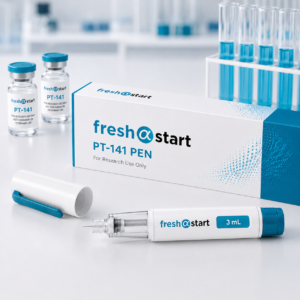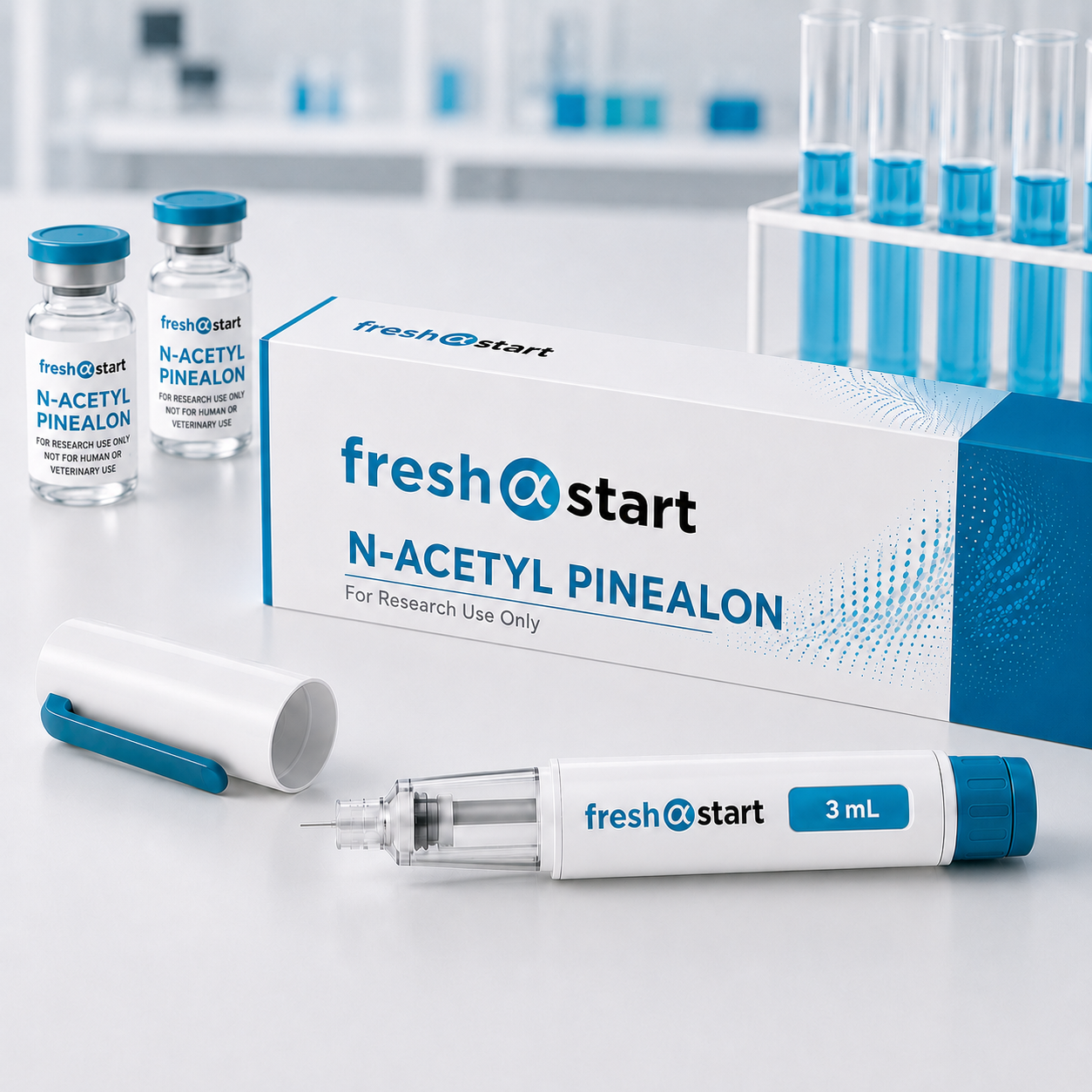
N-Acetyl Pinealon
CAS No: On request
Strengths Available: 10mg
Format: Sealed containment / vial presentations available
Volume: 3mL
What This Product Is About
N-Acetyl Pinealon belongs to a class of short peptide bioregulators frequently referenced in longevity and cellular-regulation research. It has attracted scientific attention as a research tool for exploring how neural and cognitive pathways respond under controlled conditions.
Description
What is N-Acetyl Pinealon?
N-Acetyl Pinealon is a research-grade peptide bioregulator studied in the context of cellular regulation, ageing biology, and tissue-specific signalling. Investigators have explored how N-Acetyl Pinealon may interact with regulatory pathways associated with cellular maintenance and renewal in laboratory models.
Why Researchers Became Interested in N-Acetyl Pinealon
Researchers became interested in N-Acetyl Pinealon because of its relevance to cellular-regulation and longevity research.
It provides a defined research tool for examining tissue-specific regulatory pathways in experimental models.
Key Research Focus Areas
- Cellular-regulation and gene-expression models
- Ageing and longevity research
- Tissue-specific maintenance and renewal studies
- Antioxidant and cytoprotective pathway research
- Neuroendocrine signalling investigations
- Bioregulator mechanism studies
What the Research Has Shown
In preclinical research, N-Acetyl Pinealon has been studied for its association with cellular-regulation and tissue-maintenance pathways. Mechanistic studies have explored how short peptide bioregulators may influence gene expression in target tissues.
Scientific Background and Research Context
N-Acetyl Pinealon is a modified research analogue of Pinealon, an ultrashort peptide based on the amino-acid sequence glutamic acid–aspartic acid–arginine, commonly abbreviated as EDR. Pinealon has been investigated primarily in neuroscience, cellular ageing and neuroprotection research. Experimental studies have examined the original EDR peptide in relation to oxidative stress, neuronal survival and cellular responses associated with age-related changes.
The N-acetyl modification blocks the peptide’s N-terminal end. In laboratory peptide research, this type of modification may be explored to determine whether it changes molecular stability, degradation, solubility or interactions with biological targets. These properties must be evaluated specifically for N-Acetyl Pinealon, as findings involving standard Pinealon cannot automatically be applied to the acetylated analogue.
Exploring the Science Behind N-Acetyl Pinealon
Research involving unmodified Pinealon has focused on pathways connected with cellular stress management and neuronal function. Laboratory findings have associated EDR with changes in antioxidant-related proteins, apoptosis-associated signalling and pathways involved in maintaining neuronal activity. However, many proposed mechanisms remain experimental, and some are based on cellular or animal models rather than confirmed clinical evidence.
Short-peptide studies have also investigated whether Pinealon can enter cells and interact with intracellular structures. Fluorescence-based experiments reported the presence of labelled Pinealon in the cytoplasm and nucleus of cultured cells and observed sequence-dependent interactions with nucleic-acid structures. These findings have contributed to scientific interest in whether ultrashort peptides may influence gene-regulatory processes.
For N-Acetyl Pinealon, researchers may compare these properties with those of the original EDR sequence to determine whether acetylation affects cellular uptake, molecular interactions or biological stability.
Research Context in Endocrine and Metabolic Science
Although Pinealon is most often discussed in neurological research, it has also attracted interest in broader metabolic and ageing-related studies. Oxidative stress, mitochondrial function, inflammatory signalling and gene regulation are interconnected processes that can influence both nervous-system function and metabolic homeostasis.
Research involving EDR has examined signalling proteins and transcription factors associated with antioxidant defence, cellular survival and metabolic regulation, including SOD2, GPX1, PPARA and PPARG. These observations remain mechanistic and exploratory and do not demonstrate that N-Acetyl Pinealon produces specific endocrine or metabolic outcomes.
N-Acetyl Pinealon may therefore be of interest as a laboratory tool for studying how structural peptide modifications affect cellular stress responses, neuronal–metabolic communication and age-associated molecular pathways.
Ongoing Scientific Interest
Scientific interest in N-Acetyl Pinealon is driven by the broader investigation of ultrashort peptides and the ways small structural modifications may alter their experimental behaviour. Researchers may examine its resistance to enzymatic degradation, receptor or nucleic-acid interactions, cellular localisation and effects on oxidative-stress markers.
The published evidence located for this overview is primarily centred on standard Pinealon rather than the N-acetylated form. Consequently, N-Acetyl Pinealon should be regarded as a distinct research compound requiring independent analytical, pharmacological and toxicological characterisation.
Further controlled studies would be required to determine its molecular targets, biological activity, stability and safety profile. It should not be presented as a proven treatment for cognitive decline, ageing, neurological conditions or metabolic disorders.
Ingredient Profile
Single research compound: N-Acetyl Pinealon
CAS: On request
Purity >99%
Supplied as lyophilised powder (no excipients, fillers or additives).
Active Ingredients
N-Acetyl Pinealon — 10mg
Ingredient Breakdown
N-Acetyl Pinealon: 10mg of active peptide per vial (lyophilised).
Why is N-Acetyl Pinealon described as a peptide bioregulator?
Because it belongs to a class of short peptides studied for their influence on cellular regulation and gene expression.
Is N-Acetyl Pinealon approved for medical use?
No. It is supplied strictly for research and laboratory use only, and is not intended for human or veterinary use.
Why does purity matter so much for this product?
High purity helps ensure that observed research effects are due to the material itself rather than impurities.
What does ‘research grade’ mean?
It means the product is supplied with documentation and traceability for laboratory investigation.
Is international supply available?
Yes. International fulfilment and temperature-controlled shipping can be supported where appropriate.
Research & laboratory use only. Not for human or veterinary use. Not a medicinal product, supplement, food or medical device. No therapeutic, diagnostic, cosmetic, wellness or lifestyle claims are made or implied. Analytical reference/click information is a laboratory measurement aid only and must not be applied to living systems.
Typically supplied at >99% purity, supported by batch-specific analytical data. UK-based preparation, analysis and release under scientist-led, GMP-aligned processes with full batch-level traceability. Certificate of Analysis (CoA) available on request; independent analytical verification where appropriate.
Store the lyophilised powder refrigerated at 2–8°C, protected from light and moisture; suitable for longer-term storage frozen at -20°C. Handle under appropriate laboratory conditions. For in vitro research use only.
For in vitro laboratory research only. Reconstitution, handling and experimental design at the discretion of the qualified researcher. The 300-click sealed-containment system is an analytical measurement reference only and does not represent dosing or administration guidance. Not for use in living systems.
Partner with FreshstartPharma– Where Accuracy Meets Innovation
Freshstartpharma is committed to delivering high-quality research-grade products designed for advanced scientific applications. We offer wholesale partnerships to selected businesses that share our values of integrity, quality, and innovation. Whether you’re an established distributor or an emerging research supply company, we invite you to join our network and benefit from exclusive access to our state-of-the-art product range.