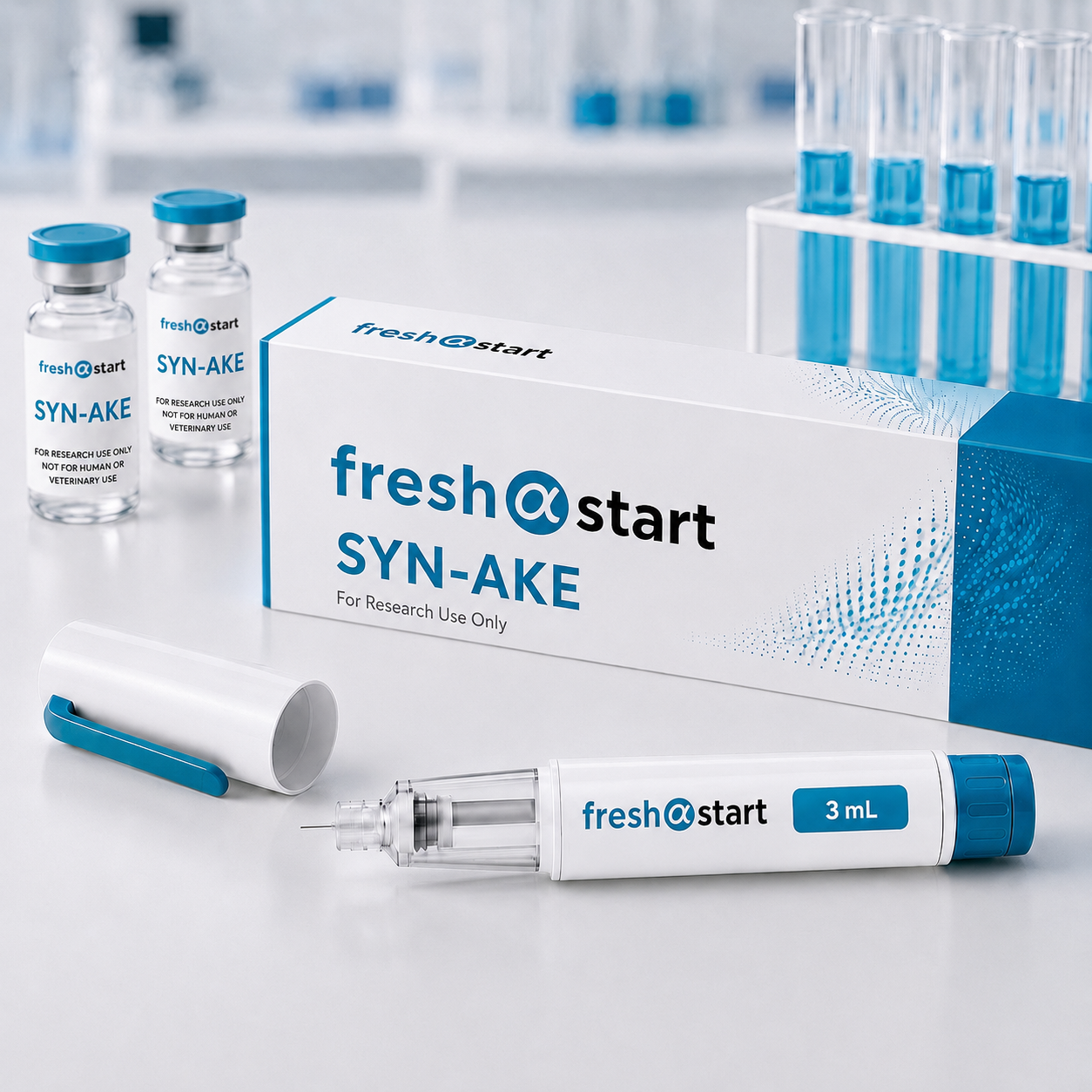
SYN-AKE
CAS No: 823202-99-9
Strengths Available: 5mg/10mg
Format: Sealed containment / vial presentations available
Volume: 3mL
What This Product Is About
SYN-AKE is the name commonly associated with Dipeptide Diaminobutyroyl Benzylamide Diacetate, a small synthetic peptide derivative inspired by the functional activity of Waglerin-1. Waglerin-1 is a peptide found in the venom of the temple viper. SYN-AKE does not contain snake venom. It was designed as a much smaller synthetic structure for research involving peptide–receptor interactions, neuromuscular signalling and cosmetic-formulation science.
Description
What is SYN-AKE?
SYN-AKE is a synthetic tripeptide derivative with the structural designation β-Ala-Pro-Dab-NHBn·2AcOH. Its recognised cosmetic ingredient name is Dipeptide Diaminobutyroyl Benzylamide Diacetate. Despite the word “dipeptide” in the ingredient name, the manufacturer describes SYN-AKE as a synthetic tripeptide with a molecular weight below 500 Da. SYN-AKE is neither botulinum toxin nor natural snake venom. It is also not a peptide hormone or injectable muscle-relaxing medicine.
Why Researchers Became Interested in SYN-AKE
Researchers became interested in SYN-AKE because it was designed to reproduce selected functional characteristics associated with Waglerin-1 while using a smaller synthetic structure.
Research focuses on its proposed interaction with muscular nicotinic acetylcholine receptors, together with its potential use in cosmetic-formulation and skin-ageing models.
More recent studies have also examined its antioxidant behaviour, cytotoxicity, genotoxicity and computational interactions with proteins involved in extracellular-matrix regulation.
Key Research Focus Areas
- Synthetic peptide-mimetic design
- Muscular nicotinic acetylcholine receptors
- Neuromuscular signal-transmission models
- Waglerin-1-inspired compounds
- Receptor-binding simulations
- Skin-ageing research
- Expression-line formulation studies
- Matrix metalloproteinase interactions
- SIRT1-related computational research
- Antioxidant assays
- Cytotoxicity and genotoxicity testing
- Topical-delivery and formulation science
- Peptide stability and degradation
What the Research Has Shown
SYN-AKE has been described as a reversible antagonist of muscular nicotinic acetylcholine receptors in experimental systems. The proposed mechanism involves limiting receptor activation and the associated sodium-ion movement involved in muscle-cell contraction.
Computational studies have investigated possible interactions between SYN-AKE and matrix metalloproteinases, including MMP-1, MMP-8 and MMP-13, as well as SIRT1. These studies generate hypotheses about molecular binding but do not prove clinical effectiveness.
In-vitro research has also examined antioxidant activity, cellular compatibility and mutagenicity at selected experimental concentrations. The results depend on the assay design and should not be interpreted as proof of safety for every concentration, formulation or route of exposure. Supplier-sponsored formulation studies have reported changes in the appearance of expression lines following topical use. However, results obtained with a finished cream cannot automatically be attributed to raw SYN-AKE alone.
Scientific Background and Research Context
SYN-AKE is a small synthetic peptide derivative developed as a functional mimetic of part of the Waglerin-1 peptide system. Waglerin-1 is a naturally occurring venom peptide associated with the temple viper. It has been studied for its ability to interact with muscle-type nicotinic acetylcholine receptors at the neuromuscular junction. Rather than reproducing the entire Waglerin-1 molecule, SYN-AKE uses a smaller synthetic structure intended to model selected receptor-interaction properties.
Its structure includes beta-alanine, proline, diaminobutyric acid and a benzylamide modification, presented as a diacetate salt. These structural features distinguish it from conventional naturally occurring tripeptides. SYN-AKE is therefore studied as a designed peptide mimetic rather than as an endogenous human signalling molecule.
Exploring the Science Behind
Neuromuscular communication normally involves the release of acetylcholine from nerve endings. Acetylcholine binds to nicotinic acetylcholine receptors on muscle cells, opening ion channels and initiating the cellular events associated with contraction. The proposed SYN-AKE mechanism involves reversible interaction with muscle-type nicotinic acetylcholine receptors. In experimental models, receptor antagonism may reduce channel activation and downstream contractile signalling.
This mechanism is conceptually different from botulinum toxin. Botulinum toxin acts primarily by interfering with acetylcholine release from nerve endings, while SYN-AKE is proposed to interact at the receptor level.
Researchers must also consider whether a peptide reaches its intended target. Molecular size, charge, formulation, concentration, skin-barrier penetration and exposure time can all influence experimental outcomes.
Research Context in Endocrine and Metabolic Science
SYN-AKE is not an endocrine hormone and is not primarily studied as an endocrine or metabolic treatment. Its relevance to metabolic science relates mainly to cellular signalling, oxidative stress, extracellular-matrix turnover and protein-regulation pathways examined in skin-ageing models. Computational studies have explored interactions with matrix metalloproteinases, which participate in extracellular-matrix breakdown, and SIRT1, a protein involved in cellular stress and metabolic regulation.
These computational interactions remain hypotheses until confirmed through biochemical binding studies, validated cellular models and appropriately controlled in-vivo experiments. SYN-AKE should not be described as regulating human hormones, metabolism or systemic ageing.
Ongoing Scientific Interest
Scientific interest continues around SYN-AKE’s receptor selectivity, stability, skin penetration and behaviour in finished formulations. Researchers are examining whether its proposed nicotinic-receptor activity can be independently reproduced and whether topical delivery produces biologically meaningful concentrations in relevant tissue layers.
Other research areas include molecular docking, antioxidant activity, extracellular-matrix enzymes, formulation compatibility and comparisons with other cosmetic peptides. Additional independent studies are needed to separate the activity of the individual peptide from the effects of the complete formulation in which it is incorporated.
Ingredient Profile
Single research compound: SYN-AKE
CAS: 823202-99-9
Supplied as lyophilised powder (no excipients, fillers or additives).
Active Ingredients
SYN-AKE— 5 mg / 10 mg
Ingredient Breakdown
SYN-AKE: 5 mg / 10 mg of active peptide per vial (lyophilised).
Why is SYN-AKE studied in skin-ageing research?
SYN-AKE is studied because of its proposed interaction with muscular nicotinic acetylcholine receptors and its possible relevance to expression-line formulation research. More recent studies have also examined antioxidant behaviour and computational interactions with extracellular-matrix-related proteins.
Is SYN-AKE made from snake venom?
No. SYN-AKE is synthetically produced. It was designed to imitate selected functional characteristics associated with Waglerin-1, but it does not contain natural snake venom.
Is SYN-AKE the same as Botox?
No. SYN-AKE is not botulinum toxin and should not be described as an injectable alternative to Botox. The compounds have different structures and proposed mechanisms.
Is SYN-AKE approved for medical use?
SYN-AKE is used as a cosmetic ingredient in certain finished topical formulations. It is not an approved injectable medicine or treatment for a neuromuscular condition.
A research-grade SYN-AKE material is not automatically approved or suitable for cosmetic formulation or human application.
Has SYN-AKE been clinically proven to remove wrinkles?
Some supplier-sponsored studies have reported improvements in the appearance of expression lines in finished cosmetic formulations. Independent evidence remains limited, and the results of a complete cream cannot be attributed solely to the peptide without appropriate controls.
Why does purity matter so much for this product?
Peptide-related impurities, incomplete reaction products, residual solvents, incorrect salt content or degradation products may influence experimental results. Identity and purity should be confirmed using appropriate analytical methods.
What does “research grade” mean?
Research grade means the material is intended for laboratory, analytical or formulation-development research. It does not automatically mean that the product is cosmetic grade, pharmaceutical grade, sterile or suitable for human administration.
Is international supply available?
International availability depends on product classification, trademark restrictions, destination-country regulations, customs requirements and rules affecting research or cosmetic raw materials.
Research & laboratory use only. Not for human or veterinary use. Not a medicinal product, supplement, food or medical device. No therapeutic, diagnostic, cosmetic, wellness or lifestyle claims are made or implied. Analytical reference/click information is a laboratory measurement aid only and must not be applied to living systems.
Typically supplied at >99% purity, supported by batch-specific analytical data. UK-based preparation, analysis and release under scientist-led, GMP-aligned processes with full batch-level traceability. Certificate of Analysis (CoA) available on request; independent analytical verification where appropriate.
Store the lyophilised powder refrigerated at 2–8°C, protected from light and moisture; suitable for longer-term storage frozen at -20°C. Handle under appropriate laboratory conditions. For in vitro research use only.
For in vitro laboratory research only. Reconstitution, handling and experimental design at the discretion of the qualified researcher. The 300-click sealed-containment system is an analytical measurement reference only and does not represent dosing or administration guidance. Not for use in living systems.
Partner with FreshstartPharma– Where Accuracy Meets Innovation
Freshstartpharma is committed to delivering high-quality research-grade products designed for advanced scientific applications. We offer wholesale partnerships to selected businesses that share our values of integrity, quality, and innovation. Whether you’re an established distributor or an emerging research supply company, we invite you to join our network and benefit from exclusive access to our state-of-the-art product range.